

The quarantines, curfews and lockdowns brought up by the pandemic have restricted movement and travel both domestically and internationally. This has weighed heavily on private consumption. The uncertainty has also weighed on both external and internal (Capex) investments.Businesses revenues have plunged and have led to a rise in unemployment figures, setting the stage for the economic crisis that we are facing today.
Summary
– Real GDP growth to take a hit in 2020 and rebounded strongly in 2021
– Forecast and updates on the ASEAN -5
– Inflation in the region has moderated
– How the travel and tourism industry suffered during the global health crisis
1. Real GDP growth to take a hit in 2020 and rebounded strongly in 2021.
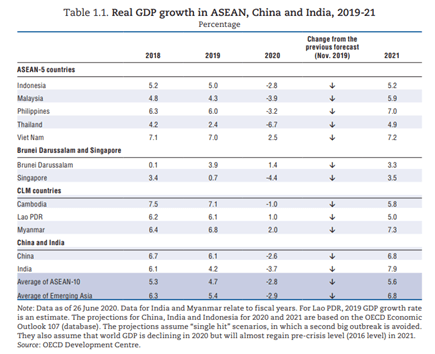
In light of these headwinds, Southeast Asia’s economy as a whole is expected to contract in 2020 by 2.8% before growth rises to 5.6% in 2021.
Individual Countries:
Indonesia – 2.8% GDP decline for 2020. The most populous country in the region continues to struggle to contain the virus, with fatality rate highest in the region at around 5.4%. Near term prospects are not encouraging as consumption pulls back and exports reel from weakening external demand. Coupled with the sharp fall in oil prices in the end of 2019 add to the heavy economic drag. The Bank Indonesia slashed benchmark interest rates by 25bps to 4% in June, a total of 1% this year. While they have signaled more easing, there has been a pause due to the need to maintain stability of the rupiah exchange rate amid low inflation expectations.
Right now in Indonesia, all attention is on the Jobs law, which has faced strong criticism and sparked widespread outcry across the country, expressed by the protests. The new law is aimed to cut red tape and boost investments. However citizens are worried about human rights and environmental concerns. For example, the sectoral minimum wage is abolished. Severance pay is reduced. Allowable overtime will be increased. The law has also relaxed environmental standards.
Malaysia – 3.9% GDP decline for 2020. The national Movement Control Order was set in place, allowing the country to steadily reign in COVID-19 cases. However the country continues to experience spikes in virus cases. Movement controls have been imposed in Kuala Lumpur recently, covering sports, recreational and religious activities.
Politics has been the main focus this year as opposition leader Anwar Ibrahim is informing the king that he holds majority in parliaments, which might lead to the parliament to dissolve and pave the way for a fresh election. Prime Minister Muhyiddin, leader of UMNO, has denounced the move.
Philippines – 3.2% GDP decline for 2020. The country has aggressively cut interest rates by 50bps to 2.25% in June. The BSP forecast inflation to average 2.3% this year and 2.6% in 2021.
Despite their limited testing capabilities and strong rise in cases, the country is slowly opening up as restaurants can now operate round-the-clock, while malls can stay open until 11 p.m. The government also plans to cut back on the curfew in Manila.
Thailand – 6.7% GDP decline for 2020. The country has navigated the pandemic really well, with cases declining steadily. Despite this, the impact of COVID will be immense. The benchmark interest rate is currently at 0.50%, the lowest in the region. If growth continues to slow, the central bank will soon need to turn to non-conventional policy options. Tax incentives have been extend to millions of middle and upper income groups to fire up consumption. The concession will allow about 3.7 million taxpayers to deduct 30,000 baht ($962) each from their total taxable income. This is on top of the 51 billion baht ($1.61 billion) cash handouts targeted at the low-income groups and welfare card holders. The country is relying on an expansive fiscal policy.
Grim tourism and trade outlook will cast an overhang on the economy for a long time to come as the pandemic disrupted international trade and travel, the nation’s key growth drivers. The country is making progress. Long term stay visas are being approved. However the mandatory 14-day quarantine is still in effect. Until there is widespread use of the vaccine, I believe that Thailand’s tourism industry will remain in limbo for the foreseeable future.
Vietnam – 2.5% GDP Growth for 2020, leading ASEAN-5 in this metric. The country has had an exceptional public health crisis management and benchmark interest rates are at 4% after a 50bps cut.
Prospects in Vietnam are looking bright as economic growth accelerated due to growth in exports and manufacturing. Exports surged 18% in September from a year earlier and Imports rose 11.6%.
On the side, Vietnam is facing floods, causing houses to submerge and fishing boats to capsize, leaving many people dead and missing. The U.S. is readying a probe into Vietnam’s currency practices.
2. Inflation in the region has moderated
Price pressures that were building up due to supply-side disturbances are slowly dissipating as supply lines are slowly reopening. However global oil prices have been on an upward trend, price controls instituted during the quarantine are also being wounded down and growing consumer demand might produce pressure in the other direction. Moving forward, expect a tug of war for inflation in the region.
According to the Asian Development Bank, Inflation rate in South East Asia is projected to grow at 1% in 2020 and 2.3% in 2021. Individual country projections : Indonesia 2% & 2.8%, Malaysia -1.5% and 2%, Philippines 2.4% 7 2.6%, Singapore -0.3% and 1%, Thailand -1.6% and 0.8% and Vietnam 3.3% and 3.5%.
A major factor behind the subdued inflation in the region has been sluggish food prices. They have relatively high weighting in local inflation baskets: Malaysia (30%), Thailand and Indonesia (36%). The price of rice may trend lower in the second half due to rising supply from Thailand, Vietnam (according to Fitch Solutions)
3. How the travel and tourism industry suffered during the global health crisis.
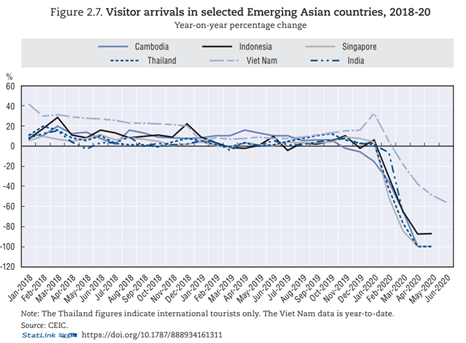
Travel and tourism were among the sectors worst impacted by the pandemic. As the spread of the virus unfolded, countries’ policy approaches in terms of regulating international flows evolved from screening or temporary quarantine to bans on all regions or even border closures. With travel restrictions were imposed in all countries in the region, this resulted in monthly visitor arrivals falling drastically beginning in March. By April, total visitor numbers across the region fell above 90%. This understandably led to an impact on airport passenger traffic.
Airlines struggled to cope with the Pandemic, downsizing their workforce in an attempt to cut costs. All staff, from Pilots to cabin crew and administrative staff were all affected. The range of measures adopted by airlines varied. Some permanently layoff-ed staff (SIA, Philippine Airlines, Cebu Pacific). Others asked workers to take unpaid leave (Cathay Pacific and Lao Airlines). While some announced wage cuts (United Arab Emirates, Etihad Airways).
Interestingly, belly-hold cargo, which is the space of the aircraft used to transport cargo unrelated to the travelling passengers and crew, actually accounts for 40-50% of airfreight. As such, the grounding of aircraft due to travel restrictions led to concerns about supply chain disruptions.
The Meetings, Incentives, Conferences and Exhibitions (MICE) sub-sector of tourism has also been heavily affected. In Thailand for example, more than 8 million MICE travellers generated approximately THB 54 billion (Thai baht) in revenue in the second quarter of 2019, according to the Thailand Convention and Exhibition Bureau. The bureau projected that 37.8 million MICE travellers would generate THB 232 billion in the October 2019-September 2020 fiscal year.
Many countries are attempting to stimulate domestic travel to keep tourism-related businesses operating and workers employed. This is achieved through subsidizing airfares and lowering fuel prices and airport charges (Indonesia). Malaysia, Singapore and Thailand (on hold) have plans to offer discounts and vouchers for use in selected tourism-related places.
Links:
https://www.oecd-ilibrary.org/development/economic-outlook-for-southeast-asia-china-and-india/volume-/issue-2_e8c90b68-en
https://data.adb.org/dataset/inflation-rate-asia-and-pacific-asian-development-outlook
https://www.bloombergquint.com/onweb/inflation-trend-a-friend-in-real-yield-contest-seasia-rates
https://www.bbc.com/news/world-asia-54460090
https://www.reuters.com/article/us-indonesia-economy-bill-exclusive-idUSKBN2050R1
https://www.scmp.com/week-asia/explained/article/3098094/indonesia-says-omnibus-law-will-create-jobs-attract-foreign
https://www.bloomberg.com/news/articles/2020-09-30/thailand-to-consider-fresh-stimulus-measures-to-revive-economy
https://www.bloomberg.com/news/articles/2020-09-28/thailand-extends-emergency-ahead-of-easing-foreign-tourist-ban
https://www.bloomberg.com/news/articles/2020-09-29/vietnam-s-economic-growth-accelerates-to-2-62-in-third-quarter
 Business Aperture