

At the end of 2019, Frost and Sullivan were commissioned by SCG Packaging to do a report on the Packaging Industry in Southeast Asia. Below, you will find below a detailed breakdown of the different segments within the Packaging Industry.
Summary
- Understanding the different Packaging Markets and the value chain
- Forestry and Pulp Market
- Corrugating Packaging Market
- Plastics Packaging Market
- Food & Beverage Packaging Market
- Drivers of the Packaging Industry & are they still relevant after COVID?
- Rising urbanization and growing middle class population
- Growing consumer focus on sustainable products
- Growth of e-commerce
- Revenue growth figures for the packaging industry
- Range: 3% (low growth) to 6% (high growth)
Southeast Asia’s Forestry and Pulp Market.
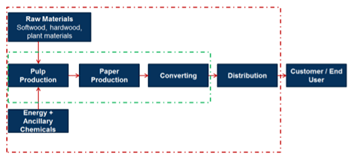
This value chain starts from obtaining the raw material, which is growing of timber and pulpwood and the logging and transportation of the wood. This is followed by the overall manufacturing process which includes production of pulp or paper through processing of wood and saw-milling of wood logs into plywood. Final products are converted such as corrugated paperboards. The last chain is the distribution to the end user. Good to note that the region has been growing due to the low labor costs and manufacturing costs. This has made pulp from Vietnam affordable. However due to ageing technology and lack of access to capital, Vietnam might not be able to sustain its position.
Southeast Asia’s Corrugating Packaging Market.
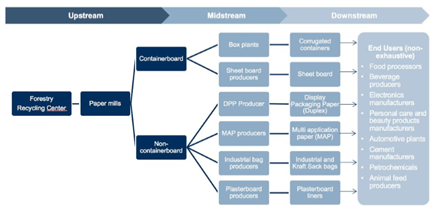
Paper packaging manufacturers produce container boards and non-container boards to be used in the consumer, construction and textile industries. Containerboards include linerboards and corrugating medium to make corrugated packaging. A sheetboard is when two linerboards combine with a corrugating medium. These are the huge boxes that carry your TV and printer! Non-container boards include display packaging paper (fancy chocolate boxes) & Kraft bags are used to package dry items like cement and starch, amongst others. Materials include woodchips or recycled paper / old corrugated containers.
Southeast Asia’s Plastics Packaging Market.
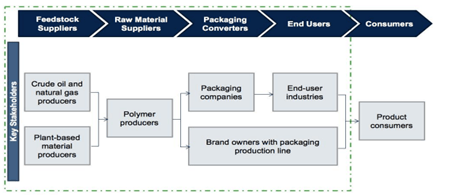
It begins with the extraction of feedstock or petro-based (Crude oil or natural gas) or bio-based (plants) plastics. Raw materials such as plastic resins and additives are added to enhance features of plastic packaging (e.g. UV stabilizers). These undergo the polymerization or polycondensation process before final processing to the plastics products (injection molding, blow molding etc).
Southeast Asia’s Food & Beverage Packaging Market.
The segment is broken down into glass, metal, flexible and rigid packaging. Due to the high standards and specific needs, property required for food and beverage. This segment is highly specialized. For example, packaging needs to provide an excellent barrier to oxygen, water vapor etc. to retain product freshness, low mass and non-breakability for transport or even ability to withstand high temperatures.
PDF download for Frost & Sullivan report:
http://market.sec.or.th/public/ipos/IPOSGetFile.aspx?TransID=282407&TransFileSeq=55
Drivers of the Packaging Industry. Are they still relevant today?
Based on the 2019 report, the packaging industry in Thailand, Indonesia, Vietnam and Philippines (TIVP) were forecasted to grow at 6.2% between 2019 and 2024. This is significantly higher than the CAGR 4.8% between 2014 and 2018. Unfortunately the report was done before 2019 ended. As such the assumptions were bold and unassuming.
Our goal is to look at the key drivers highlighted in the report and ascertain if they are still relevant today and whether the growth figures should be revised.
1. Rising urbanization and growing middle class population.
According to a 2018 ASEAN report, the urban share of the population is expected to grow from 47% in 2015 to 53% in 2020, with TIVP having more than 50% of the total share.
https://asean.org/storage/2018/11/ASEAN-Sustainable-Urbanisation-Strategy-ASUS.pdf
I believe that this will continue. The reasons why citizens want to migrate from rural to urban areas will not change. There will always be better job opportunities and better infrastructure to improve quality of life. Furthermore as the population in rural areas continues to expand, inadequate infrastructure might force citizens to move towards the city.
https://www.unescap.org/sites/default/files/SPPS-Factsheet-urbanization-v5.pdf
The incentives for governments to invest in urbanization remains strong. There is a strong correlation between the level of urbanization and the level of economic development (measured by economic output per person). This could be because urbanization often comes with a shift in employment from primary to secondary and tertiary sectors. As the benefits remain compelling, we expect governments to continue to invest in urbanization.
https://www.bloomberg.com/news/articles/2017-01-18/how-urbanization-is-driving-southeast-asia-s-economies
https://www.globalasia.org/v9no3/feature/southeast-asia-and-sustainable-urbanization_bharat-dahiya
2. Growing consumer focus on sustainable products.
The Frost and Sullivan report mentions that there is increasing awareness regarding pollution and government initiatives and policies to increase recyclability. According to a 2015 Global Corporate Sustainability Report Nielson report, it mentions that “Southeast Asian consumers are the most willing globally to pay more for sustainable products, with eight in 10 consumers (80%) preferring to buy from companies who are committed towards creating a positive social and environmental impact”.
https://www.nielsen.com/sg/en/press-releases/2015/sustainability-continues-to-gain-momentum-among-singaporeans-and-southeast-asian-consumers/
This is also seen on the ground by government and non-government initiatives to encourage sustainability practices. There is a growing number of firms who employ a circular business model that aim to reduce waste by sharing, reusing, refilling and renting.
https://ourworld.unu.edu/en/how-cities-in-southeast-asia-are-acting-on-the-sdgs-ahead-of-their-national-governments
https://blog.euromonitor.com/southeast-asia-perspective-on-the-top-10-global-consumer-trends-2020/
Despite these statistics, I feel that the impact towards the packaging industry is tough to quantify. Does this mean that firms will incorporate sustainability practices into their production and supply chain? As such, will this translate into increase in revenues for firms who use sustainable packaging?
My belief is that this will impact the PPP segment of the packaging industry. Mainly the primary packaging segment. This is because this is the most front facing
3. Growth of e-commerce.
The Southeast Asian Internet economy, covering Online Travel, e-Commerce, Online Media
and Ride Hailing sector etc, has exceeded a gross merchandise value of $100 billion in 2019. This is expected to hit $300 billion in 2025 by a recent report by Google, Temasek and Bain & Co.
This is due to the increase in mobile internet connectivity in the region, fundamental changes in consumer behavior & growing population. 90% of them are connected to the internet primarily through their phones. Majority use their phones for communication and entertainment purposes. In 2019, over 71 percent of all online retail sales in Thailand came from the mobile channel. This is due to the increasing impact of leading eCommerce platforms. The population, standing at around 640 million (2018) is forecasted to grow to 710 million in 2030 and 800 million in 2050.
https://www.blog.google/documents/47/SEA_Internet_Economy_Report_2019.pdf
https://www.dksh.com/global-en/insights/three-key-factors-driving-ecommerce-growth-in-southeast-asia
https://www.enterprisesg.gov.sg/overseas-markets/asia-pacific/asean/overview
https://asean.org/storage/2017/01/Investing-in-ASEAN-2017-.pdf
However it is good to note that bottlenecks still remain. Singapore’s RedMart and Malaysia’s Jaya Grocer briefly suspended online orders in early April, while Tops supermarkets in Thailand warned on its website that deliveries were limited during this period. This is due to both the increase in order volume and the hit in productivity because of safety measures. Indonesia and Philippines have an archipelago of 17,000 and 7,000 islands and its geographical makeup has traditionally poised a challenge for last-mile delivery. These logistical challenges will remain for the foreseeable future.
https://www.spglobal.com/marketintelligence/en/news-insights/latest-news-headlines/covid-19-whets-appetite-for-e-commerce-in-southeast-asia-but-bottlenecks-remain-57985529
Revenue growth figures for the packaging industry
Frost and Sullivan expects the revenues for the packaging market across TIVP to grow to USD 72.7 billion by 2024, from approximately 51.0 billion in 2018. This shows an estimated 6.09% CAGR over the 6 years. The total consumption volume of packaging products is forecasted to grow at 5.7% CAGR across the four countries, while the average Selling Price of Packaging Products is expected to stagnate or grow at 1 to 2%.
The paper packaging products market across APAC is forecasted to grow at a CAGR of 4.0%. It grew at 2.71% over the past 5 years. The Plastic packaging products market across APAC is forecasted to grow at 7.6%, significantly higher than the 4% previously. While Indonesia is the largest packaging market (close to 40%), Vietnam is expected to show the highest growth (6.67%).
As such having a range of revenue growth figures from 3% (same growth as the previous years) to 6% (strong growth) with a safe average of 4% will be reasonable.
 Business Aperture